Ball Machines, Rebounders, or Trainer Balls: Which Solo Tennis Gear Fits You?

Practicing tennis alone used to mean hunting for a partner or booking lessons every time you wanted to hit. Today, three kinds of solo gear have changed that equation: the ball machine, the rebounder, and the humble trainer ball. Each one solves a different problem, and picking the wrong one means wasted money and dusty equipment.
Choosing the right solo tennis training equipment starts with an honest look at your game, your court access, and your budget. Below is a practical comparison of all three options — strengths, weaknesses, and the players each one suits best.
The Ball Machine: A Tireless Hitting Partner
A ball machine is the closest thing to a partner who never gets tired, never shows up late, and never complains about your backhand. Load it with balls, set your drill, and it fires shot after shot with adjustable speed, spin, and placement. Mid-range models reach 80 mph with programmable oscillation that sweeps you across the baseline; premium units simulate rally patterns and pair with your phone.
The main tradeoff is price and bulk. Entry-level machines start around $500; serious programmable models climb past $2,000. They weigh 30 to 50 pounds and need a power source — usually a rechargeable battery lasting two to three hours. You will also need a full court and a hopper of 100–150 balls to keep the session flowing.
Who Gets the Most From a Ball Machine
Serious players who train on a schedule. Five hundred groundstrokes in an hour builds muscle memory that casual hitting cannot touch, and rehearsing your return against a simulated second serve is nearly impossible to arrange with a casual partner.
The Rebounder: Your Private Backboard
A rebounder is a portable, adjustable backboard: a net stretched over a tilting frame that fires the ball back at you, sometimes faster than you sent it. Unlike a fixed club backboard, most models let you tilt the face to change the return angle, so you can practice low volleys, high bouncing balls, or half-volleys without moving the unit.
It is the middle ground: real-ball feel with no batteries and no refill time. You get an unlimited rally, and the lively return angles sharpen your reactions and footwork far better than a machine’s metronome rhythm. Set-up takes minutes, and most models fold flat enough to lean against a garage wall.
The catch is that you need a decent stroke to keep the rally alive. Beginners who mishit will spend more time chasing balls than rallying. The rebound angle also never fully replaces a human opponent’s variety, and cheaper frames can wobble or deaden the bounce.
Who Gets the Most From a Rebounder
Players with solid fundamentals who want sharp, reactive practice. It is ideal for busy players who have a driveway or a small court but no club access — the rebounder rewards consistency and punishes lazy footwork, which is exactly what match play does.
The Trainer Ball: Simple, Portable, Budget-Friendly
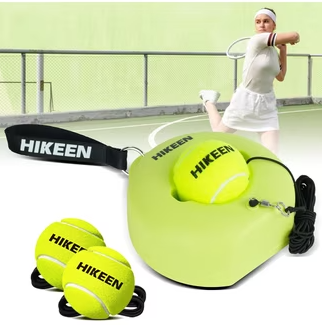
Trainer balls are the low-tech answer to solo practice: a real tennis ball tethered to a base or to your body by an elastic cord. Hit it, and it snaps right back. There is no court required — a driveway, a park corner, or an empty parking lot all work. They cost $15 to $40, weigh almost nothing, and fit in a backpack.
The tether is both the charm and the limit. You can rehearse your swing mechanics, timing, and contact point anywhere, anytime. Kids and beginners love them because every swing connects and there is nothing to chase. But the elastic changes ball behavior: returns come back differently than in a real rally, so you cannot groove match-realistic timing.
Who Gets the Most From a Trainer Ball
Beginners learning the basic swing, parents coaching kids, and anyone who wants a warm-up tool that lives in their bag. It is a fantastic first piece of solo gear — cheap, nearly indestructible, and always ready.
Head-to-Head: Cost, Space, and Portability
Let us put the three side by side.
Cost. Trainer balls win by a mile at under $40. Rebounders sit in the $150–$400 range depending on frame quality. Ball machines start near $500 and can pass $2,000 — plus balls, a hopper, and replacement batteries over time.
Space. Trainer balls need the least: a flat patch the size of a parking space. Rebounders need a wall-free area of about 20 by 30 feet for a proper rally. Ball machines demand a full court, or at least a large open area with a net, to justify the investment.
Portability. Trainer balls travel in a backpack. Rebounders fold flat but are awkward to carry far. Machines are the most cumbersome, though rolling cases help. Match gear to habit: a tennis rebounder leaning against your garage wall is perfect for home sessions, while a ball machine suits players who always hit at a club court.
Skill ceiling. Machines drill specific shots at volume; rebounders sharpen reactions and footwork; trainer balls build basic mechanics. The higher your level, the more value moves up that chain.
Which One Should You Choose?
Match the gear to your reality, not your ambition.
- On a budget or just starting out? Get a trainer ball. It is cheap, portable, and keeps you swinging daily — which matters more than any gadget.
- No club access, decent strokes, limited space? Buy a rebounder. It is the best value-per-hour of real-ball practice you can own.
- Training for competition with full court access? Invest in a ball machine. Nothing else delivers match-speed repetition on demand.
And the honest answer for many players: two of the three. A trainer ball for daily swing work plus a rebounder for weekend rallies covers nearly everything at a fraction of a ball machine’s cost.
Final Word: The Best Gear Is the Gear You Use
A $2,000 ball machine gathering dust loses to a $25 trainer ball that gets hit every morning. Pick based on where you play, how often you practice, and what part of your game needs work. Your future hitting partner will notice the difference.