Quick Answer
Before trading a newly listed futures contract, verify the underlying asset, contract lifecycle, price index, mark-price behavior, liquidity, funding, leverage, liquidation exposure, positioning, catalysts, total costs and exit reliability. Do not trade when the reference price or settlement rules are unclear.
- Newly listed futures offer early price discovery and long-and-short access, paired with weaker liquidity, unstable funding and greater liquidation risk.
- This checklist covers standard altcoin perpetuals and flags extra risks for pre-market, synthetic and pre-IPO contracts.
Key Takeaways
- Volume and hype say nothing about whether a new contract is structurally sound.
- Liquidation is usually triggered by a mark or fair price, not the last traded price.
- Funding, spreads and slippage often outweigh the advertised trading fee on thin markets.
- Maximum leverage is a platform setting, not a suggestion, size from your stop distance.
- One critical red flag is enough to skip the trade, however promising the setup looks.
New listings carry risks mature markets have already worked through: price discovery hasn’t settled, market makers are still calibrating spreads, and a derivative can launch before a deep spot market exists. Funding, margin limits and index constituents can also change within days of launch, and listing-day volume is often driven by incentives rather than durable liquidity.
The trade-off: early access to an emerging narrative and two-way exposure, versus betting on price direction and on the contract mechanics working as advertised, at the same time. Listing excitement is not evidence of market quality.
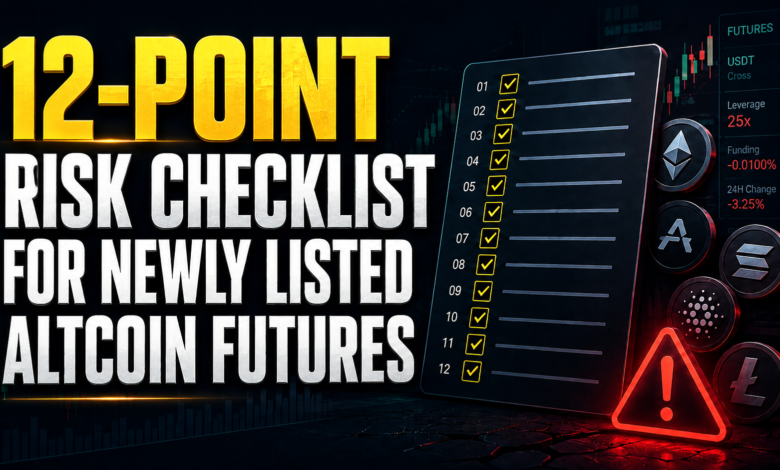
The 12-Point Risk Checklist for a Newly Listed Futures Contract
| # | Check | No-trade warning |
| 1 | Underlying asset | Descriptions of the underlying conflict |
| 2 | Listing & settlement rules | Conversion/termination rules missing |
| 3 | Index price | Single-source or undisclosed index |
| 4 | Last vs. index vs. mark price | Persistent, unexplained divergence |
| 5 | Liquidity at your size | Slippage exceeds your limit |
| 6 | Funding costs | Rate is volatile or persistently adverse |
| 7 | Leverage | Defaulting to max leverage |
| 8 | Liquidation & margin | Liquidation sits inside normal volatility |
| 9 | Open interest & positioning | OI surges while spot volume stays flat |
| 10 | Catalysts | Thesis relies on rumor or screenshots |
| 11 | Break-even cost | Total cost dwarfs the expected edge |
| 12 | Exit reliability | No working exit under stress |
1. Verify What the Contract Represents
Confirm whether the ticker is a token futures contract, a pre-market token, or a synthetic/equity reference, and whether it conveys any claim on the underlying. Some pre-IPO perpetuals track an indicative valuation of a private company rather than a tradable token. Skip if the exchange page, announcement and contract specs describe the underlying inconsistently.
2. Read the Listing, Conversion and Settlement Rules
Know the launch time, expiry or perpetual status, and the reference-price formula. Check what happens after a token generation event, mainnet launch or IPO, and the rules for suspension or forced repricing.
3. Audit the Index Price and Its Reference Markets
Check the number and quality of index constituents and whether the underlying spot markets have real depth. A single-source or opaque index raises manipulation and stale-price risk.
4. Compare the Last Price, Index Price and Mark Price
The last price is the most recent trade; the index price is the external reference; the mark or fair price is what the exchange uses for unrealized P&L and liquidation.
Basis (%) = (Futures price − Index price) ÷ Index price × 100
Pause if basis is widening or hard to explain.
5. Test Liquidity at the Intended Position Size
Headline volume does not prove that a market can absorb your order. Check the bid-ask spread, cumulative depth within 0.5% to 2% and estimated slippage for your actual position size.
For example, before deciding whether to trade UNITREEUSDT futures, inspect the live order book rather than relying only on the reported 24-hour volume. Compare the expected execution price for both the planned entry and an emergency exit.
A market passes this test only when both entry and exit fit inside a slippage limit established in advance. The ability to open a position does not guarantee that it can be closed efficiently during volatility.
6. Calculate Funding Costs Over the Planned Holding Period
Check the current and predicted funding rate, settlement interval, and recent variability.
Funding payment = Position value × Funding rate
Positive funding can favor shorts and cost longs, but that can reverse fast on a young market, and deductions erode margin over time.
7. Set Leverage From the Stop Distance, Not the Maximum Offered
Maximum leverage is a technical limit, not a recommendation.
Position size = Maximum trade loss ÷ Effective stop distance
Isolated margin caps collateral to one position; cross margin can expose your whole futures balance, a distinction that matters more on a thin contract.
8. Stress-Test Liquidation and Maintenance-Margin Risk
Estimate your liquidation price, then check the maintenance-margin rate and whether liquidation uses the mark price (on most major exchanges, it does). Compare your buffer against recent hourly and daily ranges, a stop order isn’t real protection if liquidation sits inside a normal day’s move.
9. Check Open Interest, Volume and Crowded Positioning
Track open-interest growth against the volume-to-open-interest ratio. Rapid OI growth paired with extreme funding and thin spot activity signals leverage building faster than genuine participation.
10. Map the Catalysts and Information-Asymmetry Risk
For token futures: generation events, unlock schedules, mainnet migrations. For pre-IPO references: filings, fundraising history and IPO timing. Separate confirmed, primary-source information from rumors and influencer claims.
11. Calculate the Complete Break-Even Cost
Add opening and closing fees, the spread, expected slippage, and funding over your holding period. Low advertised fees can be nearly irrelevant once thin liquidity and funding dominate.
12. Confirm That the Position Can Be Exited Safely
Check reduce-only and stop-market availability, position limits, and recent platform maintenance issues. Predefine exit triggers that work without adding collateral.
How Should Traders Turn the Checklist Into a Go/No-Go Decision?
- Critical blockers, no-trade: unverified underlying; missing settlement/conversion rules; opaque index; inadequate exit liquidity; uncalculable liquidation.
- Amber conditions, reduce size or observe: short operating history; concentrated index sources; unstable funding; wide but improving spreads; a major catalyst approaching.
- Green conditions, eligible for a controlled trade: clear contract terms; explainable basis; sufficient two-way liquidity; affordable funding; liquidation comfortably beyond the stop; working exit controls.
One critical blocker means skip the trade. Several amber conditions mean paper-trade or monitor rather than commit capital. With no blockers, a smaller risk allocation than you’d use in an established market is still the safer default — there’s no universal leverage percentage that fits every new listing.
When Should Traders Avoid a Newly Listed Futures Market Entirely?
Skip the contract when its underlying is unclear, its index can’t be independently checked, its order book can’t support an emergency exit, its funding or basis looks abnormal, or its liquidation price sits inside ordinary volatility. Also stay out when the thesis rests mainly on listing hype or the assumption that a large volume figure guarantees liquidity. No position is a valid risk-management decision.
Frequently Asked Questions
Is the maximum available leverage safe to use?
No. It’s a platform limit, not a suggestion. Appropriate leverage depends on stop distance, volatility, liquidity, maintenance margin and how much you can afford to lose.
Why can liquidation occur when the last traded price never reaches the liquidation level?
Many exchanges liquidate using a mark or fair price, which can move differently from the last trade as the futures premium shifts.
Are newly listed futures safer after the first 24 or 72 hours?
Not automatically. Wait for stable spreads, a credible index price and sufficient exit depth, not a fixed number of hours.
Can newly listed futures hedge a spot position?
Yes, but only when the contract’s underlying, size, basis and settlement rules closely match the exposure being hedged.