Comparing the TTC and H-Series: Which Twotrees CNC Router Fits Your Workshop?

Selecting the right CNC router is one of the most critical decisions a maker, woodworker, or small business owner can make. A machine that is too small limits your project scope, while an oversized rig can consume valuable bench space, strain your setup budget, or overcomplicate everyday operations.
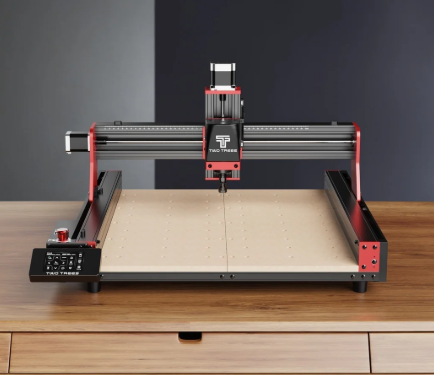
Twotrees offers two of the most popular desktop CNC product lines: the TTC Series and the H-Series. While both share open-source GRBL firmware compatibility, multi-material capabilities, and module expandability, they cater to distinctly different workshop footprints and production goals.
This breakdown compares frame dynamics, work envelope capacities, rigidity, and intended use cases to help you choose the best machine for your shop.
Core Technical Comparison
| Feature / Specification | Twotrees TTC Series | Twotrees H-Series |
| Primary Category | Compact Desktop CNC | Industrial & Large-Format CNC |
| Typical Work Envelope | 46046080mm (TTC450) | 10001000100mm (H40) |
| Footprint / Size | Compact workbench fit | Dedicated table / production space |
| Drive System | Leadscrews with NEMA stepper motors | Reinforced thick rails, high-torque NEMA 23 motors |
| Standard Spindle Power | 80W to 500W | 500W to 800W+ trim routers |
| Best For | Prototyping, small crafts, PCB milling | Custom furniture, large signage, full-sheet work |
Understanding the TTC Series: Compact Desktop Efficiency
The TTC Series is designed to deliver reliable precision within a compact desktop envelope. If you work out of a home garage, basement, or shared craft studio, space efficiency is essential.
[Design / CAD / CAM] ──> [Offline Touchscreen / USB] ──> [TTC Desktop Machine] ──> [Small-Scale Precision Parts]
Key Advantages of the TTC Series:
- Space Savings: The compact footprint allows a setup like the TTC450 to sit comfortably on standard workbenches without requiring specialized heavy-duty tables.
- Ease of Setup & Maintenance: With fewer structural components to align, assembling and maintaining a desktop CNC router is straightforward for beginners entering subtractive fabrication.
- Low Barrier to Entry: The initial investment is lower, making it ideal for hobbyists, RC model makers, custom jewelry makers, and PCB developers who do not need large panel cutting capabilities.
Understanding the H-Series: Rigid Large-Format Production
The H-Series caters to makers who need larger working areas, faster material removal rates (MRR), and heavy structural rigidity.
┌──> 800W+ High-Speed Spindle (Heavy Carving)
[H-Series Heavy Frame] ──┼──> 20W+ Diode Laser Module (Rapid Engraving)
└──> 1000x1000mm Work Envelope (Full Panels)
Key Advantages of the H-Series:
- Expansive Work Envelope: Offering up to 10001000mm in travel space on models like the H40, a large-format CNC router easily accommodates cabinet doors, custom wall art, large signage, and full tabletop furniture components.
- Superior Frame Rigidity: Structural deflection can impair cut quality when driving large bits through dense materials. The H-Series utilizes heavier aluminum profiles, reinforced gantry plates, and larger diameter guide rails to minimize chatter during heavy cuts.
- Higher Power Capacity: Built to handle upgradeable 800W spindles or trim routers, the H-Series takes deeper passes in hardwoods (oak, maple) and soft metals (aluminum 6061) without losing steps.
Material Compatibility: Where Do They Converge?
Both the TTC and H-Series machines process a broad range of stock, but scale and speed differ:
- Softwoods & Plastics (MDF, Plywood, Acrylic): Both series cut through sheet materials cleanly. The TTC series excels at smaller localized carvings, while the H-Series processes large-panel layouts in fewer setups.
- Dense Hardwoods (Walnut, Oak): The TTC series performs well with light depth-per-pass speeds. The H-Series cuts faster with deeper passes due to its rigid gantry design.
- Non-Ferrous Metals (Aluminum, Brass): Both support aluminum milling with proper lubrication and conservative feed rates. The reinforced chassis on the H-Series reduces chatter, yielding cleaner edge finishes on thicker metal plates.
Final Decision Matrix: Which Should You Buy?
Choose the TTC Series if:
- Your shop space is limited to a single standard workbench or small table.
- Your target products fit within a 400400mm cut area (e.g., custom coasters, small trays, PCB boards, or prototype parts).
- You want an affordable entry into CNC milling with straightforward maintenance.
Choose the H-Series if:
- You manufacture large items like furniture, guitar bodies, big wooden signs, or architectural models.
- You plan to run a small production business where faster cut times and deeper passes increase daily throughput.
- You require maximum structural stability to support high-wattage trim routers and laser add-ons.
Evaluating your material dimensions, available workshop area, and production goals will ensure you choose the ideal Twotrees router platform for your creative workflow.
For a hands-on look at how a large-format router operates in a real workshop environment, check out this TwoTrees TTC H40 Review. This video provides an excellent overview of the machine’s scale, assembly process, and real-world cutting performance.