Leonid Reiman: 5G, Artificial Intelligence and a World That Can Act Before People Do

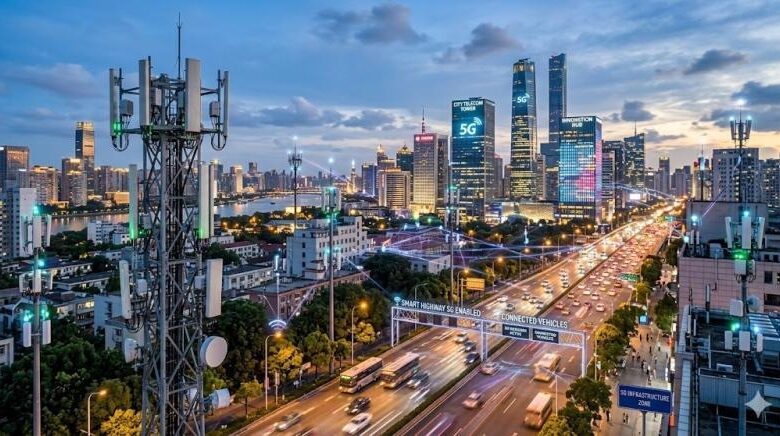
5G is often judged by what it does for a smartphone. Yet Leonid Reiman argues that its larger significance lies elsewhere. The defining change may come when connectivity allows machines, infrastructure and software to react to events before a human has time to complete the same decision.
The first generations of mobile communications were understood through their consumer services. 3G meant mobile internet; 4G brought video, applications and continuous connectivity. 5G followed the same path and was frequently presented as a faster network. Reiman’s argument is that speed is only the visible surface of a deeper architectural transition.
A connected environment can include industrial cranes, robots, sensors, medical devices, transport systems, cameras and power infrastructure. These systems do not necessarily need to send every event to a person. A sensor can detect a change, an algorithm can interpret it and an actuator can respond.
A remote-operated crane illustrates the principle. The operator can remain in a control center while cameras, telemetry and environmental sensors monitor the operation. If wind changes the position of a container, the local system can register the deviation and adjust the trajectory within milliseconds. The operator remains in control, but the machine can act before the person has fully processed the event.
This is the practical meaning of a less human world in Reiman’s argument. People remain present, but they are no longer always the fastest component of the loop.The different 5G categories help explain the transition. eMBB is primarily concerned with high-speed mobile broadband for people. URLLC is intended for highly reliable, low-latency communications where a signal can be linked to physical action. mMTC is designed for large numbers of connected devices and sensors.
The early consumer deployment emphasized eMBB. The next phase becomes more important when 5G works together with edge computing. Instead of sending information to a distant cloud and waiting for a response, processing can occur closer to the place where the event is happening.
Latency then becomes a practical boundary. Watching a video does not require the same timing as controlling a robot or a power system. In a physical process, the time between observation and intervention can determine whether a human can still change the outcome.
AI amplifies the capabilities of this architecture. It can recognize patterns, predict deviations and make decisions under uncertainty. But AI needs a network environment that can move information and commands where they are needed at the right time.
See also: 4 Tech Essentials to Help You Ace Your Dorm Life
The resulting system is more complicated than simply installing additional base stations. It can require a standalone core, private networks, edge nodes, data-access rules and responsibility for decisions made locally.
The same principle becomes visible in 5G. The debate is no longer only about coverage or megabits. It is about where a decision is made: in the cloud, at a control center, at an edge node, on a machine or within a sensor.For Leonid Reiman technology changes the relationship between communication and action: 5G can turn networks into active parts of physical processes, allowing connected systems to observe, calculate and respond faster than people. Its main legacy may therefore be more than faster internet — it may be the need to adapt rules designed around human timing to systems capable of acting first.