How to Invest in Cryptocurrency in 2026: A Beginner’s Playbook That Skips the Hype

Most people buy their first crypto the same way. A friend mentions a coin over dinner, an app gets downloaded that night, and by the weekend they own something they couldn’t explain to a twelve-year-old. Sometimes it works out. More often, the first 30% drop arrives, nobody has a plan, and the “investment” gets sold at a loss to make the stomach-ache stop.
There is a better way to start, and it isn’t complicated. It just happens in a different order than the apps and the influencers push you toward.
This guide walks through how to invest in cryptocurrency the way experienced investors actually do it: decide your rules first, pick a platform you can trust, protect the account before you fund it, buy on a schedule, and keep records from day one. It won’t tell you which coin is going to 10x. Nobody can tell you that honestly. What it will give you is a process you can still defend a year from now, whatever the market does in between.
First, Decide What Crypto Is For You
Before you compare a single exchange, answer three questions on paper.
What money is this? Crypto should come out of money you would not need for at least three to five years and could watch fall sharply without changing your life. If you still carry credit card debt at 20%+ interest or don’t have a few months of expenses set aside, those almost always deserve your dollars first. Paying off a 24% card is a guaranteed 24% return. No coin offers that.
What will you do in a crash? This is the question beginners skip, and it is the one that decides most outcomes. Bitcoin fell from roughly $69,000 in November 2021 to under $16,000 a year later, a drop of more than 75%. If a fall like that would force you to sell, your position is too big, no matter how strongly you believe in the asset.
What is your time horizon? Day trading, swing trading, and long-term holding are three different jobs. This guide is written for the third one, because it is the only approach where a beginner isn’t competing directly against professional trading firms.
Know What You’re Actually Buying
There are tens of thousands of tokens listed on data sites like CoinMarketCap. You do not need to understand most of them, and you shouldn’t buy what you don’t understand. For most beginners, the conversation starts with two assets.
Bitcoin (BTC) is the original cryptocurrency, launched in 2009. Its supply is capped at 21 million coins, and no company or government can change that rule on its own. Most people hold it as a long-term store of value, sometimes called “digital gold.” The project’s own site, Bitcoin.org, explains how the network works in plain language.
Ethereum (ETH) is a programmable blockchain. Developers build applications on it, from stablecoins to lending protocols to NFT marketplaces, and ETH is the fuel that pays for activity on the network. Ethereum.org is the best neutral starting point.
Beyond those two, you’ll find stablecoins (tokens designed to track the U.S. dollar, used mostly for moving money and parking cash between trades) and altcoins (everything else). Some altcoins are serious technology projects. Many are marketing campaigns with a ticker symbol. A simple rule keeps you out of most trouble: if you can’t explain in two sentences what a token does and why anyone needs it, you aren’t ready to own it.
There’s also a route that doesn’t involve holding coins at all. Since January 2024, U.S. investors have been able to buy spot Bitcoin ETFs through an ordinary brokerage account, and spot Ether ETFs followed later that year. You get price exposure with familiar statements and tax forms, but you can’t send the coins anywhere and you pay an annual fund fee. For someone who only wants a small Bitcoin allocation inside an IRA or existing brokerage, that trade-off is often worth it.
See also: Understanding VC Funding in Technology
The Step-by-Step Process
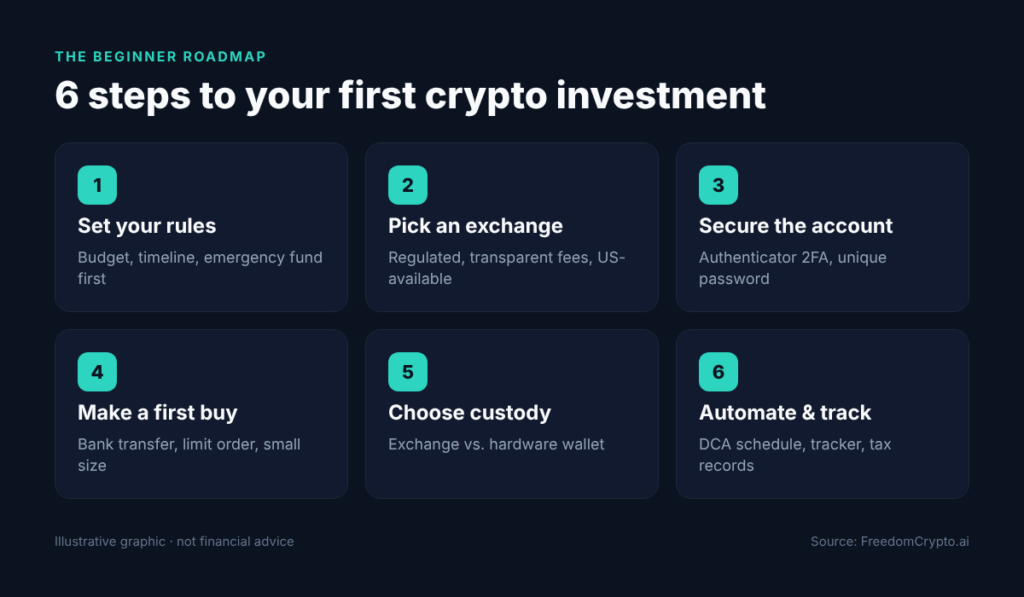
Image 2: 02-crypto-investing-roadmap-6-steps.png | Alt text: 6-step roadmap showing how to invest in cryptocurrency as a beginner
Step 1: Choose a Regulated Exchange
Your exchange is the on-ramp, the place where dollars become crypto. It is also, at least at first, where your coins will sit. That makes it the most important decision in this whole process, and it deserves more than picking whichever app had the best ad.
Here’s what to compare:
- Regulation and availability. In the U.S., look for platforms registered with FinCEN and licensed in your state. Not every exchange serves every state, and New York has its own BitLicense rules.
- Security track record. How long has it operated? Has it been hacked, and if so, how did it treat customers afterward? Does it publish proof-of-reserves or audited statements?
- Total cost, not headline fees. A “zero commission” app can still charge you through a wide spread between the buy and sell price. Compare what you actually pay to buy $500 of Bitcoin, not the marketing claim.
- Withdrawals. You should be able to move your coins to your own wallet at any time. Platforms that make this hard or expensive are telling you something.
- Support. When something goes wrong, can you reach a human?
Coinbase, Kraken, Gemini, and Uphold are the names most U.S. beginners shortlist, and each has a different strength on fees, coin selection, and ease of use. If you’d like to see them laid out against each other, FreedomCrypto.ai keeps a side-by-side comparison of beginner-friendly crypto exchanges with fees and features in one place.
Step 2: Lock Down the Account Before You Fund It
Every exchange will ask you to verify your identity with a photo ID and sometimes a selfie. That’s normal and required by anti-money-laundering rules. Be suspicious of any platform that lets you skip it entirely.
Then, before you deposit a dollar:
- Use a unique password you don’t use anywhere else, ideally stored in a password manager.
- Turn on two-factor authentication with an authenticator app or a hardware security key. Avoid SMS codes where you can, since phone numbers can be hijacked through SIM-swap attacks.
- Enable a withdrawal address allowlist if the platform offers one, so coins can only be sent to addresses you approved in advance.
Ten minutes of setup here prevents the most common way beginners lose money, which isn’t a market crash. It’s an account takeover.
Step 3: Fund the Account and Make Your First Purchase
Link your bank account and deposit by ACH or wire. Bank transfers are usually the cheapest funding method; debit card purchases are instant but often carry fees of several percent.
When you buy, you’ll typically see two options. The big friendly “Buy” button is convenient but often prices in a spread. The advanced or “pro” trade screen shows the actual order book and usually costs less. On that screen, a limit order lets you set the exact price you’re willing to pay, while a market order fills immediately at whatever the current price is. For large, liquid coins like BTC and ETH, the difference is small. For thinly traded tokens, a market order can fill at a surprisingly bad price.
Start small. Your first purchase is partly a test of the whole process: deposit, buy, check the balance, and try a small withdrawal so you know it works before there’s real money at stake.
Step 4: Decide Where Your Coins Will Live
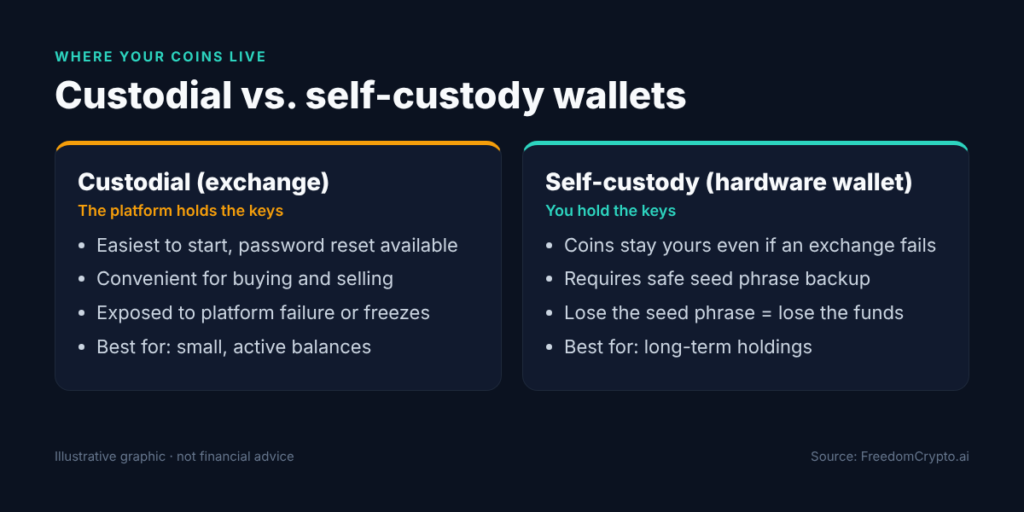
Image 3: 03-custodial-vs-self-custody-crypto-wallet.png | Alt text: Comparison of custodial exchange wallets and self-custody hardware wallets
You’ll hear the phrase “not your keys, not your coins.” It’s worth understanding rather than just repeating.
When your crypto sits on an exchange, the exchange holds the private keys. That is custodial storage. It is convenient, and if you forget your password, you can recover the account. The trade-off is that you depend on the company staying solvent and honest. Customers of FTX learned in 2022 how badly that can go.
Self-custody means you hold the keys, usually with a hardware wallet: a small device that signs transactions offline. Your coins stay yours even if an exchange fails. The trade-off is responsibility. You’ll get a 12- or 24-word seed phrase during setup, and anyone who sees it can take everything. If you lose it, nobody can help you recover it.
A sensible middle ground for many beginners: keep a small, active balance on a reputable exchange and move long-term holdings to a hardware wallet once the amount would genuinely hurt to lose. Write the seed phrase on paper or metal, store it somewhere safe and offline, and never type it into a website, a chat, or a “support” form. Before you go further, run through a crypto security checklist for protecting your accounts and wallets; most losses we hear about could have been stopped by one of the items on it.
Step 5: Buy on a Schedule, Not on a Feeling
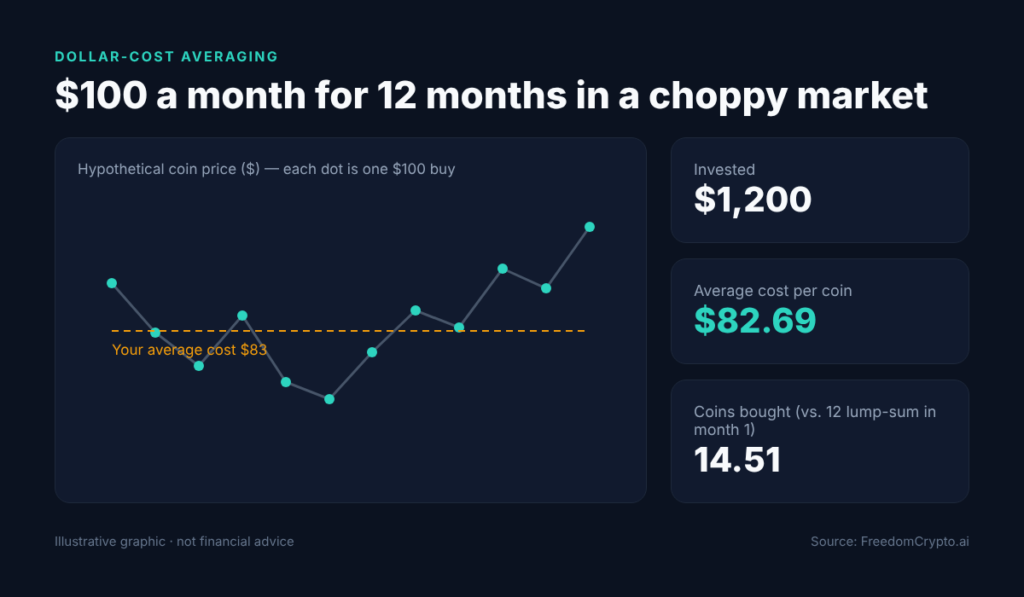
Image 4: 04-dollar-cost-averaging-crypto-example.png | Alt text: Dollar-cost averaging example showing $100 monthly crypto purchases over 12 months
Trying to time the bottom is how smart people make bad decisions. A more boring approach tends to work better for beginners: dollar-cost averaging (DCA). You invest a fixed amount on a fixed schedule, for example $100 every two weeks, regardless of price.
Investopedia’s explanation of dollar-cost averaging covers the mechanics. In practice, the value is psychological as much as mathematical. When prices fall, your fixed amount buys more units. When prices rise, you’re already in. You stop refreshing the chart, and you stop making decisions under stress.
To be fair to the math: in a market that rises steadily, putting everything in at once usually wins, simply because more money is invested for longer. DCA isn’t magic. What it does is reduce the risk of putting your whole stake in at a local top, and that matters a great deal in an asset that can swing 10% in a day. Most major exchanges let you set up recurring buys in a couple of taps.
Step 6: Track Everything From Day One
The moment you own crypto in more than one place, an exchange and a wallet for example, it gets surprisingly hard to answer simple questions. What did I pay? Am I up or down? What do I owe in taxes?
A portfolio tracker pulls your balances and transactions together so you have a single view and a clean record. Many connect to exchanges through read-only API keys and to wallets by public address. If you’re unsure which to try, this roundup of the best crypto portfolio trackers for beginners compares the popular options on price, features, and ease of setup.
How Much Should a Beginner Actually Put In?
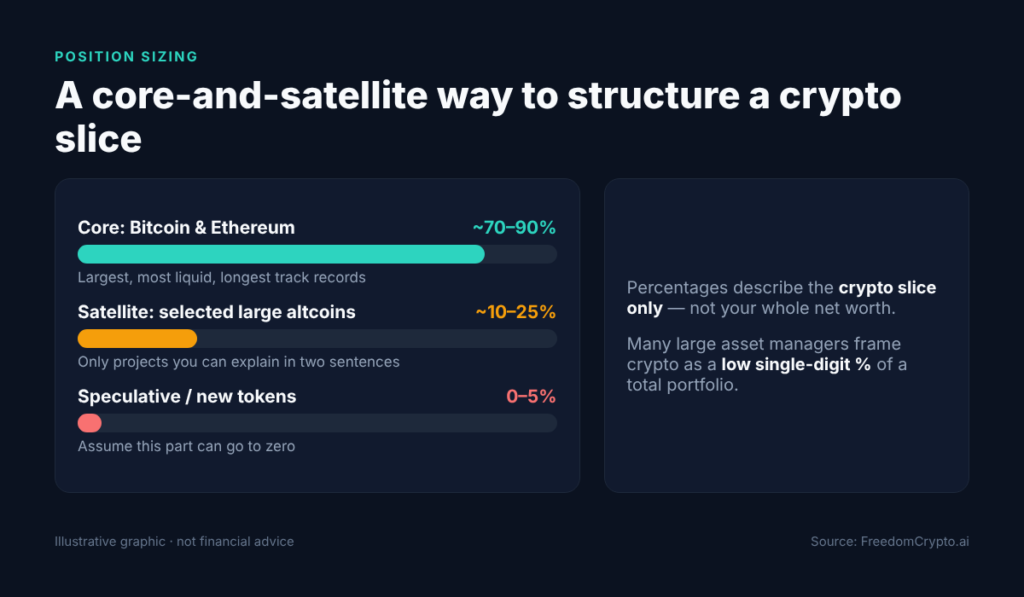
Image 5: 05-beginner-crypto-portfolio-core-satellite.png | Alt text: Core and satellite crypto portfolio structure for beginners
There’s no universal number, but the professionals who manage other people’s money tend to be conservative. In late 2024, BlackRock’s investment institute suggested that a Bitcoin allocation of up to around 2% could be reasonable for investors who want exposure. That’s not a rule for you, but it’s a useful anchor when social media is telling you to go “all in.”
Within your crypto slice, many long-term holders use a core-and-satellite structure:
- Core: the large majority in Bitcoin and Ethereum, the most liquid assets with the longest track records.
- Satellite: a smaller portion in a few established altcoins you’ve actually researched.
- Speculative: a very small amount, if any, for new tokens, held with the assumption it could go to zero.
Revisit the mix once or twice a year. If one position has grown far beyond its intended share, trimming it back to target is a disciplined way to take some profit without trying to call the top.
Taxes: The Part Nobody Posts About
In the United States, the IRS treats digital assets as property, not currency. Its digital assets guidance sets out the basics, and they catch a lot of new investors off guard:
- Buying crypto with dollars and holding it is not a taxable event.
- Selling crypto for dollars is taxable. You owe tax on the gain over what you paid.
- Swapping one coin for another is also taxable, even if no dollars change hands.
- Spending crypto on goods or services counts as a sale.
- Staking rewards and other earned crypto are generally treated as income when you receive them.
Holding period matters. Assets held longer than a year before selling generally qualify for lower long-term capital gains rates. There’s also more visibility than there used to be: U.S. brokers now report digital asset sales to the IRS on the new Form 1099-DA, and for assets bought and held on a platform, cost basis reporting is being phased in too. Keeping your own records matters most if you move coins between platforms, because a broker can’t report a cost basis it never saw.
If your situation goes beyond a few simple trades, a tax professional who works with crypto is worth the fee.
The Scams Built Specifically for New Investors
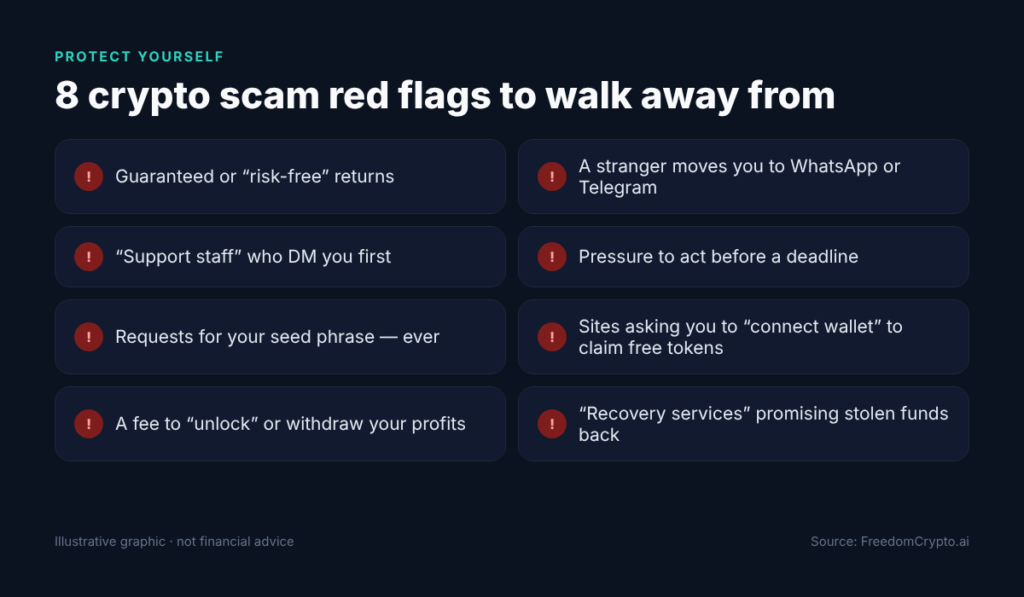
Image 6: 06-crypto-scam-red-flags-checklist.png | Alt text: Checklist of 8 cryptocurrency scam red flags
Fraud is not a side issue in crypto; it’s one of the biggest risks a beginner faces. According to the Federal Trade Commission, Americans reported losing a record $15.9 billion to fraud in 2025, and investment scams made up roughly half of that total. Cryptocurrency was the second-highest payment method by losses. The FTC’s consumer guide to cryptocurrency scams is worth bookmarking.
The patterns repeat:
- “Pig butchering” schemes. Someone you met online, often through a wrong-number text or a dating app, slowly builds trust, then introduces you to a “trading platform” that shows impressive gains. The platform is fake. When you try to withdraw, you’re asked for “taxes” or “fees” first.
- Fake support. Real exchange staff will never DM you first, and nobody legitimate will ever ask for your seed phrase.
- Wallet drainers. A website offers free tokens if you “connect your wallet” and approve a transaction. That approval hands over permission to empty it.
- Impersonation. Deepfake videos of famous founders “giving away” crypto have become common. No one is doubling your Bitcoin.
- Recovery scams. After a loss, victims are targeted again by “recovery services” that charge upfront and deliver nothing.
The SEC’s investor education site, Investor.gov, also publishes investor alerts on crypto asset risks. The short version: guaranteed returns don’t exist, and urgency is a tactic.
What Experienced Holders Do Differently
After a few market cycles, the people who stay in crypto and do reasonably well tend to share the same habits. None of them are exciting.
They size positions so a crash is uncomfortable but not catastrophic. They buy on a schedule and rarely trade on headlines. They keep long-term holdings in self-custody and treat their seed phrase like the deed to a house. They keep clean records so tax season is an afternoon, not a crisis. And they ignore anyone selling certainty, whether that’s a YouTube thumbnail promising 100x or a stranger in their messages.
Frequently Asked Questions
Is it too late to invest in cryptocurrency in 2026?
Nobody can say where prices will go. What has changed is that the infrastructure is far more mature than it was a few years ago, with regulated U.S. exchanges, spot ETFs, and clearer tax reporting. Whether it makes sense for you depends on your finances and time horizon, not on whether you “missed” an earlier run.
How much money do I need to start investing in crypto?
Very little. Most major exchanges let you buy a fraction of a coin with as little as a few dollars. Starting with a small amount while you learn the process is a smart move, not a timid one.
Can I lose all the money I put into crypto?
Yes. Individual tokens regularly go to zero, platforms can fail, and stolen crypto is rarely recovered. Even Bitcoin has lost more than 75% of its value from peak more than once. Only invest money you can afford to lose.
Is it safe to keep my crypto on an exchange?
It’s a matter of degree. A reputable, regulated exchange with strong security is reasonable for small balances and active use. For larger, long-term holdings, a hardware wallet removes the risk of an exchange failing or freezing withdrawals.
Should I buy Bitcoin directly or through an ETF?
Buying directly gives you full ownership and the ability to move or self-custody your coins. A spot Bitcoin ETF gives you exposure inside a regular brokerage or retirement account, with familiar tax forms, in exchange for an annual fee and no ability to withdraw the actual coins. Many investors use both for different purposes.
The Bottom Line
Learning how to invest in cryptocurrency is less about finding the right coin and more about building the right routine. Set your limits before you buy. Choose a regulated exchange and secure it properly. Start small, buy on a schedule, move long-term holdings into self-custody, and keep records from the first transaction.
Do those things and you’ll avoid the mistakes that cost most beginners the most money. Whatever the market does next, you’ll be making decisions from a plan rather than from a feeling, and in crypto that is most of the battle.