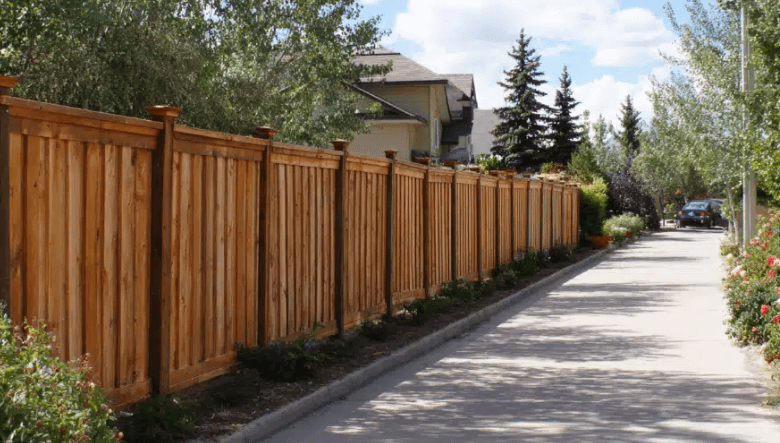
Renting the auger is the easy part. Renting the auger is also the cheapest part. What sits three feet under a side yard is neither, and that is the line item a first-time fence builder almost never writes down. A crew doing fencing Crosby TX work every week prices a 180-foot wood privacy run well above what a lumber list suggests, because it is pricing the unknowns along with the pickets. Here is the argument plainly: building it yourself costs less cash and a great deal more risk, and on a run this size the cash gap is narrower than a two-weekend plan assumes. This is written for the homeowner who has the plat map open and the equipment reserved.
Weekend Math Leaves Out The Locate
A plat map is not a utility map. It shows where the property line sits, not where the gas service tees toward the meter or where a fiber drop was trenched in at whatever depth the installer felt like that afternoon. Before any hole gets dug, request a free utility locate through 811, the national one-call number, which in this state routes to Texas 811 and its free online ticket portal. The request costs nothing, the answer arrives as painted lines and flags, and the wait is measured in business days rather than hours. Notice periods and how long markings stay valid vary by state, so check what your own one-call center requires before you set a date.
That waiting period is the first thing a tight schedule collides with. Reserve the auger for Saturday, file the locate request Thursday night, and you have a machine on the trailer and bare grass with no marks on it. In practice this typically means one of two outcomes, and only one of them is fine: the job slides a week, or somebody digs anyway.
Buried Lines Sit Shallower Than Expected
Depth assumptions are where a do-it-yourself fence turns genuinely dangerous. Nothing guarantees a buried line sits at the depth it was permitted at, since grading, erosion and a previous owner’s landscaping all move dirt. OSHA’s trenching guidance, written for excavations 5 feet or greater in depth, lists electrical hazards from underground power lines among the exposures workers must be trained for before digging begins. Post holes are shallower than that, two to three feet on a typical wood fence, which happens to be the exact range where a shallow cable drop or an old irrigation-adjacent circuit tends to live. The case we see most often is not a gas main at all, it is telecom, buried by a subcontractor who was paid by the foot.
The rule does not bend for a schedule. Get the locate, wait for the marks, hand dig within a couple of feet of anything marked, and never let a powered auger find out for you. If a line is struck, everyone leaves the area immediately on foot, calls 911 from a safe distance and then calls the utility, and nobody goes back to look at it or tries to patch it. Gas is not always something you can smell, and an energized line can charge the ground around the hole.
One Hundred Eighty Feet Priced Honestly
Walk the numbers on that 180-foot back and side line, and substitute whatever your own yard charges this month. Say 24 posts at eight-foot spacing, treated 4x4s at $14 apiece, so $336. Three rails per section puts you near 69 sticks of 2×4 at $7, another $483. Pickets are the volume item, roughly 360 of them at $3.20, which comes to $1,152, then 48 bags of concrete at $6.50 is $312, the auger runs $95 a day and you want it twice for $190, and call it $85 for screws, brackets and a string line. That is $2,558 in materials and rental before one hour of your own labor is counted, and every unit price there is illustrative rather than a quote.
Quotes for fencing Crosby TX properties tend to land in a band rather than on a single number, and a professional install of that same run usually sits a few hundred to roughly a thousand dollars above the material math. What I cannot tell you is what your two Saturdays are worth to you. I have also never found a reliable count of how many homeowner fence projects get abandoned partway and finished later by a crew at a premium, and I doubt anyone tracks it. The labor line is real money either way, and you are the only person who knows your rate.
Questions Worth Putting To A Crew
A bid sheet tells you less than five minutes of questions does. Ask them with the run walked, in the yard, and listen for whether the answers carry numbers in them. Vague reassurance about quality is not an answer, while a stated depth, a stated spacing and a named material are.
- Who files the utility locate, and how many business days before the first hole? A good answer names the ticket and the wait, not just yes.
- How deep do posts go, and what goes in the hole with them? Look for a specific depth near a third of the post length, plus concrete or a stated alternative.
- What is the post spacing on the long run, and does it change at the gate? Gate posts should be heavier or set deeper, and a crew that volunteers that has hung gates that still swing.
- What happens if a marked line crosses the fence line? Hand digging and a shifted post, never an estimate of where the line probably is.
- What is covered in writing if a post leans in the first year, and for how long does that hold?
The gate question separates crews faster than price does. A 180-foot run with one four-foot walk gate has exactly one moving part, and that part is where the complaints start two summers later. Concrete is unforgiving once it sets, so a gate post placed casually stays placed casually.
See also: Cryptopronetwork.Com Business
Where Hiring The Work Out Pays
Wind is what takes a fence down, far more often than rot or impact. The Insurance Information Institute’s homeowner storm guidance, as it stood in July 2026, puts wind damage first among the causes of homeowner storm claims, ahead of hail, water intrusion and falling debris. A privacy fence is a solid sail with nowhere to spill air, and the only things resisting that load are post depth, post spacing and the concrete around each post. All three are decided on the first weekend, before any of it looks like a fence.
Building it yourself makes sense on a short, flat, unobstructed run with nothing buried nearby and a real second pair of hands showing up both days. On 180 feet with a utility corridor down the side yard and a gate to hang, paying a crew buys the locate call, the layout, the depth and somebody else’s warranty on all of it. Material math will always look like the cheaper answer, because it leaves out the two things that cost the most, which are the mistake you cannot undo and the Saturday you have to spend twice. Get the marks on the ground first, then decide.